Tuesday, March 29, 2011

Tunnel Vision; Waiting for the A Train, The Sophisticated Pigeon

The New York Times
By RANDY KENNEDY
Published: March 5, 2002

In the annals of strange subway stories -- some pure urban legend, some alarmingly real -- there has always been a menagerie of animals.

Stories of alligators roaming the tunnels, of pet snakes loose on trains, of rats tough enough to survive the third rail. There have been eyewitness accounts of live chickens, on their way from poultry market to soup pot, escaping from sacks and running amok through the cars. Recently, someone posted a story on the Internet about a man in the subway walking a dog that was being ridden by a cat, the dog and cat dressed in matching Uncle Sam hats. (The story was accompanied by a photograph to prove that it was not made up by Dr. Seuss.)

But one subway animal story has been so persistent and widespread that it simply cried out to be investigated: the case of the train-riding pigeons of Far Rockaway.

A little more than a year ago, a motorman and a conductor on the A line, which terminates at the Far Rockaway station, swore to this reporter that it was true. They said it was common knowledge among longtime riders and those who worked on the line. Pigeons, they said, would board the trains at the outdoor terminal and step off casually at the next station down the line, Beach 25th Street, as if they were heading south but were too lazy, or too fat, to fly.

The inquiry began the other afternoon, when the question was put to a car cleaning supervisor at the terminal. He appeared suspiciously nervous about the subject. ''Oh, no,'' he said. ''Our trains have no pigeons.''

But Andrew Rizzo, 44, a cleaner sweeping in a nearby train, looked around and smiled as if he were finally going to get to reveal his secret.

The birds ride the trains all the time, he explained, motivated not by sloth but by simple hunger and ignorance: when the trains lay over at the terminal to be cleaned, for about 20 minutes, pigeons amble through the doors, looking for forgotten crumbs. But being pigeons, they do not listen for the announcement that the train is leaving, and the doors close on them. They ride generally for one stop, exiting as soon as the doors open again.

''If you don't know what's going on,'' said Mr. Rizzo, pushing his glasses up on his nose, ''you'd think they knew what they were doing. It's a little freaky.''

Mr. Rizzo has a soft spot in his heart for pigeons, who helped him make a living in Central Park in the late 1980's when he was less gainfully employed. He would wear straps with tiny cups of birdfeed on his arms and head and would soon be covered with pigeons, Hitchcock-style. He would put out a donation box, and pull in $200 a weekend. ''I still feed them sometimes,'' he said. ''I feel bad for the little guys.'' But he also admitted: ''I run them out of the train. I don't want them to make no mistakes, if you know what I mean.'' Despite his efforts, they make many little mistakes.

Mr. Rizzo and many of his fellow employees at the terminal have become amateur ornithologists. They said that pigeons -- known vulgarly as air rats, more elegantly as rock doves -- ride trains at several outdoor terminals and stations, like the Stillwell Avenue station in Coney Island.

Francisco Peña, a conductor on the A, said he watched them step off his train and promptly fly back to the Far Rockaway terminal. Perhaps not quite as impressive as the blue homing pigeon reported to have flown 7,200 miles from France back to Vietnam in the 1930's, but still, Mr. Peña said, not bad.

Frank Maynor, a car cleaner, noted how the sparrows and seagulls, also plentiful at the terminal, are never bold enough to venture into the cars. The sparrows can be seen hopping onto the threshold, looking longingly inside. The gulls loiter outside, like thugs, waiting to tear pizza crusts from the bills of unsuspecting pigeons as soon as they carry them out.

''They shove the pigeons around,'' said Mr. Maynor, disapprovingly. ''But they're going to evolve and start going into the trains, too. They're giving up a lot of food to the pigeons.''

On the subject of evolution, Sarah Canty, another cleaner, said she had noticed that the pigeons might be evolving into more alert straphangers. ''When the bell goes off, you watch them,'' she said. ''They know the bell like we do.'' And indeed, when the next bell rang, signaling that a train was about to depart, several pigeons could be seen high-stepping it out of the trains.

But there are those who have either not learned or are yearning to break free from the nest. And at 10:45 yesterday morning, it finally happened: a dark, plump bird with iridescent purple feathers around the neck took a ride. Alone with the bird in the car was Eduard Karlov, a retired procurement officer for the United Nations.

Mr. Karlov, originally from Moscow, glanced over at his fellow passenger and smiled. ''He does not bother me, and, in fact, I find him rather amusing,'' he said, adding, ''I cannot give you any more details with respect to pigeons, however.''

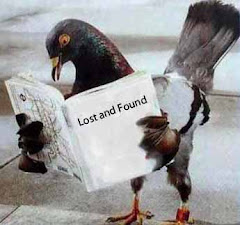
Photos: (William C. Lopez for The New York Times)(pg. A1); With no tokens to its name, a pigeon that got on the A train at the Far Rockaway station in Queens pondered its next move, top. Workers say pigeons often board there and exit one stop later. (Photographs by William C. Lopez for The New York Times)(pg. B3)

Read more ...

Monday, March 28, 2011

Training The Individual

By Jas. C. Foster, Jr.
The American Racing Pigeon News
September, 1954

We hear much about methods of training pigeons. "I fly my pigeons forty miles every day;" "I force fly them thirty minutes around the loft every morning," and so on. How about it? What is the right method, or is there such a thing as a good method; a satisfactory system for conditioning racing pigeons? Personally, I do not think there is.

The baseball season is now well under way. Presumably all regular players are in as good condition as it has been possible to get them. How did they get that way?

Sometime ago, after the winter layoff, they all were called in to the spring training camps. Individually, they were in very different states of physical condition. Did the managers put them all through the same course of training? Certainly not.

Some were overweight, gross and sluggish. Nothing but long hours of hard work would take off the excess fat and put them into condition. They got this work, day after day. Others were underweight and too fine. Some had had operations or illnesses from which they had fully recovered. Did these men get the same conditioning treatment as the fat and sluggish players. Certainly not. They had to be built up and brought into work slowly as they toughened up and could take it.

I do not think there are greater differences in physical condition between ball players or race horses than between racing pigeons. Nor do I think there are greater differences between the same number of racing pigeons.

It would sound rather silly, wouldn't it, to ask a trainer how much work he gives his race horses to put them in racing trim. Some horses take several times as much work as others. In fact, both work and diet must be fitted to the needs of individual horses or there would be no hope of ever winning a Kentucky Derby. The work one horse may need to put it into condition would kill off another horse altogether.

It is the same way with racing pigeons. There can't be any system suitable for all of them. Different pigeons require very different amounts of work. They all, of course, need some work. They may be started off together and given calisthenics up to, say, 100 miles. Then the way each individual pigeon takes its work and reacts to it must be studied carefully. After the calisthenics stages are past, the work given to each individual pigeon must be regulated to meet its individual needs.

Racing pigeons should be conditioned as individuals, which they are, not as a flock. I do not think there is, nor can be, any successful "system" for training racing pigeons; one that will be suitable to all individuals of any race team. I think each racing pigeon must be treated as an individual and trained and conditioned as an individual. Any fancier who relies upon a "system" of training is very apt to find that this system fits only a small percentage of his race team and that the rest of the team never come into high racing form. As challengers for the top honors, the rest of these pigeons are useless, although many of them may potentially be among the best racers of the team.

The fancier who thinks of his pigeons as so many race horses and attempts to handle each one so as to meet its individual needs is the fancier most likely to ship an entry of pigeons to a race in such condition that each one will have a real opportunity to offer top contention. Unfit pigeons don't win. No matter how good any system may be, it will not fit the needs of most of the pigeons in any team, nor will it bring them into top racing form.

Sunday, March 27, 2011

Hobby takes off for B.C. man

The Toronto Star
Saturday, April 20 1991

Earl Kitto trains and races homing pigeons

VERNON, B.C. (CP) - Earl Kitto gave his son's homing pigeons away twice. They came back. Twice. So now he has an absorbing hobby: racing pigeons. Some of his older birds have raced home to Vernon from as far away as Smithers, B.C., 725 kilometres (450 miles) as the crow - or pigeon - flies.


FLIGHT ATTENDANT: Some of Earl Kitto's prize pigeons have raced home from as far away as 725 kilometres. He has a flock of 42 adult birds.


Released daily from their loft for exercise, the flock of 42 adult birds circles above Kitto's land north of this Okanagan community for two or three hours at a stretch. The birds are athletes and Kitto begins conditioning them early at about 4 months. "You just take them in cages about a mile away the first time," he says, adding he keeps moving farther out each day.

They are comical to watch as they overshoot the slippery loft roof and clumsily negotiate turns in the air. "It takes a while to learn to turn and some don't come back for a couple of days." Some return with broken legs. Kitto splints them. He loses about six birds a year - to hawks, in collisions, or during the confusion created by electrical storms.

Both males and females race, and Kitto's hens routinely out do the cocks. Birds race against the clock. They're trucked to a release point, often several hundred kilometres from home, and all are released at a pre-arranged time. As each bird returns to the loft, an identifying band is removed from its leg and placed in a specially designed timing clock. The winner is the one with the fastest over-all speed. Some racing pigeons, flying with a tailwind, have been clocked at 90 km/h (55 m.p.h.).

Barring disease or accident, pigeons live for about 10 years and can race competitively until about age 7. Most race best between ages 2 and 4. Some bird owners take racing very seriously. When betting takes place, fortunes have been won and lost by the tick of a timing clock. "It's very competitive," says Kitto. "You can make and lose friends real quick."

Pigeon fanciers include Queen, Boxer

WEYMOUTH, England (Reuter) - Clint Eastwood, Mike Tyson and Queen Elizabeth are said to share a common passion: all are devoted to pigeons. That passion can be expensive. In Japan and Taiwan, for instance, prices equivalent to $40,000 U.S. have been quoted for a single bird.

The most sought-after pigeons are from the Jan Aarden strain, which race distances of up to 1,300 kilometres (810 miles), and the Janssen breed, popular with the British Royal Family, including the Queen, who keeps them at her Sandringham estate. The pigeon, a relation of the rock dove, has fascinated man for more than 5,000 years. Egyptian pharaohs and roman warriors used them to carry messages - a trait that news agency founder Paul Julius Reuter later exploited in mid 19th century Europe to bridge communication gaps.

The sport of pigeon racing, which first became popular in Belgium in the early 19th century, is fraught with hazards. In 1912, of 1,638 pigeons released in Marennes, France, to fly to Manchester, England, only 31 arrived. Now breeder Tony Hayne is worried that the thinning of the ozone layer is affecting his birds. "In years gone by, if you released 10 pigeons, you expected 10 pigeons back," he says. "I don't know if it's the change in the climate, with this hole in the atmosphere, but bad races seem to be increasing. A lot of pigeons are being lost for no reason at all."

Hayne, one of Britain's top breeders, and his wife Mary run a pigeon stud farm called Ponderosa Pigeons U.K., based at Weymouth on the southwestern coast of England. Racers are not always scrupulous. Last year, a Dutch racer was banned for 30 years for tampering with the clock used to time his pigeons. "Pigeon nobbling (cheating) has been going on since the sport began," Hayne says.

Sex is another handy racing aid. Female birds are said to fly home much faster if they know their mate was left at home with another female admirer. However, it seems that the owners are the ones who suffer the most torment. "It's no good if you've got a weak heart," says Mary Hayne. "Tony's so nervous I can't even talk to him on race days." Hayne, who is involved in planning an international race for 100,000 birds in Barcelona to coincide with the start of the 1992 Olympic Games in Spain, admits that the anxious wait for a homecoming racing pigeon is tough on the nerves. "You wouldn't believe the number of times I've been standing out there scanning the skies and timed in a sparrow or a butterfly by mistake."

Past sports promotions
Pigeon racing

Saturday, March 26, 2011

Cabbage

Sprinkle Sea Salt over chopped up Cabbage, and give to the feeder's daily.

Twenty words or less TCC Loft series
Chas. Heitzman passed this on to Tony Paszterko years ago, and Tony still gives cabbage to the feeders today.

Feeding greens to our breeder's is also discussed in "The Practical Side of Pigeon Racing"
by Leon Petit

Friday, March 25, 2011

Early Warning Pigeons

The New York Times
By ANTHONY DePALMA
Published: March 15, 2003

WINGED SENSORS -- Dozens of pigeons were distributed to Marine units in Kuwait to warn them of chemical attacks. Like the canaries that miners once carried in case they ran into explosive gas, the pigeons fall victim to dangers more quickly than humans. The Marines will also be equipped with $12,000 mechanical sensors. The pigeons cost $60 each, plus seed.

Read more ... 

Thursday, March 24, 2011

Homing Pigeons, Close to Home

The New York Times
By HENRY FOUNTAIN
Published: January 18, 2005


Homing pigeons are renowned for their ability to navigate over long distances, and after decades of study scientists are pretty sure they know how the birds do it. They use their sense of smell to figure out where they are and the position of the sun to determine the direction they must fly.

But less is known about how pigeons navigate when they are close to home, in more familiar surroundings. Many researchers have thought that in such situations the birds must rely, at least partly, on visual cues.

"There's been controversy about whether familiar landmarks have been used," said Jessica Meade, a doctoral student in the Animal Behavior Research Group at the University of Oxford in England. "Because there was no tracking of the birds along the homeward route, the hypotheses aren't very clear."

Ms. Meade and two colleagues, Dr. Dora Biro and Dr. Tim Guilford, set out to rectify that situation, using small Global Positioning System loggers attached to the backs of 15 homing pigeons. These devices, which weigh about an ounce, use satellite signals to record precise location fixes every second.

The researchers released the birds about three miles from home, and each bird had about 20 flights from the same point. The results are published in Proceedings B, a journal of the Royal Society.

At first, the researchers found, the birds' routes were highly variable. But after a number of flights the birds began to follow the same path from flight to flight, even though they were not necessarily the most direct routes home.

This route stereotypy, as it is called, implies that the birds use visual cues to navigate: they follow the same cues in order to reduce the memory load on their brains.

"We were also surprised that the routes were longer than they needed to be," Ms. Meade said. This implies that the pigeons use a chain of landmarks by themselves or in combination with compass bearings, but that they do not integrate direction and distance. If they did, Ms. Meade said, they would realize their routes are not the most efficient ones.

Whatever the precise method, the work suggests that homing pigeons shift from primarily compass navigation to visual navigation when they get near their home.

"It seems like they use a different strategy when they are very familiar with a task," Ms. Meade said.

Read more ...

Wednesday, March 23, 2011

Using pigeons to carry the news

By Jackie Kemp
Friday, 4 March 2011

...I marvel at the rapid transformation in the way that news and entertainment are delivered to the public. Yet in their day the telegraph (invented in 1837), the modern typewriter (1867), carbon paper (1872), and the telephone (1872) were just as revolutionary. The arrival of the Linotype machine and the rotary press in the same period coincided with the removal of stamp duty and press censorship.

The use of pigeons to carry news also occurred around that time and is part of the folklore of the press. Though I have never seen it they say there is a pigeon loft in the old Herald building in Mitchell Street, which has stood empty since we left it for Albion Street in 1980.

Sometimes, listening to the stories of old-timers, I have found myself feeling a certain scepticism, thinking that perhaps they were apocryphal. Certainly most of the yarns are risible. Yet the use of pigeons for news, documented in various histories of the press, must have seemed during its brief epoch as innovative as fibre-optics in our own time.

It is hard for us to imagine how slowly news arrived until the technological revolution of the nineteenth century. In 1815 the news of Napoleon's defeat at Waterloo took four days to reach London; the news of his death at St Helena six years later was brought by sea and took two months.

Telegraph lines began to spread from the 1840s and, according to a new history of Reuters to be published next week, the use of pigeons sprang up to fill gaps in the chain.

It is often thought that Julius Reuter was the first to employ pigeons in this way but this was not the case. In the field before him were Charles Havas, the founder of the French agency of that name (whose integrity was to be compromised by French Government subsidy), the Rothschilds and other financers. The development of international news services was driven by the need for financial information as well as for political and diplomatic intelligence.

Reuter brought a high degree of organisation to the deployment of pigeons. In 1950 there was a gap of 76 miles between the German telegraph line linking Aachen to Berlin and the French system joining Brussels to Paris.

Reuter made an agreement with an Aachen pigeon-fancier who supplied 45 trained birds to maintain a service with Brussels, where they were sent each day by rail to fly back next day.

The first pigeons were released at dawn. To guard against loss or delay, three birds carrying identical messages were sent up each time. A trusted assistant received them in the pigeon loft in Aachen, placing the messages in a sealed box to be sent round to the office where Reuter sat waiting, smoking and reading the papers.

When the box arrived Reuter and his two clerks sprang into action to transcribe the densely hand-written sheets. Runners hurried them to the telegraph office for dispatch to Berlin.

Even in modern times Reuter men occasionally fell back on pigeons in emergencies (for example during the Normandy invasion) but their systematic use by newspapers must have persisted only for some years after 1850.

There was an anecdote on the old Manchester Guardian, where my father worked before the war, about a reporter of the old school who was sent to cover a Gladstone campaign meeting. He went by bike from Manchester to, let us say, Altrincham, and was alarmed to see that a rival had brought pigeons.

Full of despair, he set off back to Manchester as soon as he could, his shorthand notebook in his pocket. As he cycled, the sky darkened and it began to rain. To his immense relief he saw the pigeons of his competitor settle on the dome of the town hall. On that occasion, at least, he was first with the news. No date attaches to this story but it may have been some time before 1867, when Gladstone won a landslide victory and formed his first administration.

Another hoary old anecdote concerns the sports reporter who, towards the end of a local derby in Edinburgh, had written out the scoreline and inserted it under the pigeon's wing. Just before the final whistle, Hearts scored. The reporter (I fear he was biased) raised his arms in exultation, releasing the pigeon prematurely. As it flew off he shouted after it: ''Hearts 2, Hibs 1!''

In those days the pigeon and the telegraph were used to deliver news of national or financial import, of wars and treaties, of markets collapsing or prospering. Nowadays Reuters world-wide system of computer-driven financial information and dealing systems is of first importance, a vehicle for the currency flows which so inconvenience national governments from time to time. In the sixties the volume of foreign exchange transactions was about $3 trillion a year. By 1987 it had reached $87 trillion, a staggering rate of growth.

Much of the new information technology delivers entertainment or trivia across frontiers, reinforcing American domination of popular culture. But even in the old days the cabled message could be vacuous, as we are reminded by the couplet on the illness of the Prince of Wales by Alfred Austin, whose appointment as poet laureate in 1896 aroused widespread derision:

Across the wires the electric
message came:
He is no better, he is much
the same.

Then, as now, the means to communicate provided no guarantee that there was anything to say.

Read more ...

Sunday, March 20, 2011


1898 Photograph of a Passenger Pigeon.


The last wild Passenger Pigeon was shot by a 14-year-old boy in Ohio in 1900, while the last known individual of the passenger pigeon species, named "Martha" after Martha Washington, died at 1 p.m. on the 1st of September 1914 in the Cincinnati Zoological Garden. She was 29.

Read more ...

Saturday, March 19, 2011

Bath Twice A Week

Heitzman's birds were given baths throughout the year. To control lice he added two ounces of sodium-Fluoride to four gallons.

Twenty words or less TCC Loft series

Friday, March 18, 2011

They Don't Brake for Statues; Racing Pigeons Hurry Home to Brooklyn, at 55 M.P.H.

The New York Times
By ALAN FEUER
Published: October 16, 2001

There were 1,500 pigeons packed into traveling crates, and the Knights of Columbus taproom smelled like a barn. It was race night and the birdmen talked to one another about storm fronts and prevailing winds. They talked to their birds.

They synchronized their race clocks and tagged their pigeons with numbered rubber bands. They drifted toward the bar to make their boasts and lay their bets. Someone bragged about his slate-roofed coop -- a recent import from Belgium. Behind their beer cups, the other birdmen frowned with lust.

At midnight, the crates were stacked in a trailer and the birds were hauled 400 miles from Bay Ridge, Brooklyn, to Cadiz, Ohio. The race would start in the morning when the pigeons were freed at 8 a.m. Flying at 55 miles per hour, with a tailwind and a bit of luck, it would take them about seven hours to return.

For a pigeon racer, there is no greater joy than watching the heavens suddenly offer up a homer returning to its loft. This is a pleasure unknowable to the ordinary man. ''If I wasn't flying pigeons, I'd be dead,'' said Frank Viola, 82. ''My birds are my life.''

There are perhaps a few hundred pigeon racers in New York City, and earlier this month nearly all of them entered the Frank Viola Invitational at the Knights of Columbus lodge in southern Brooklyn. Breeders from around the country -- Oklahoma, Florida, Texas, Hawaii -- enter their birds in the race. It is considered the Kentucky Derby of the pigeon racing set.

In the 1950's, it was hard to walk down a street in Bensonhurst or Coney Island without a flock of pigeons twinkling in the sky like a handful of falling dimes. The last 50 years, however, have been tough on the pigeon game. Teams have disbanded; new racers are hard to find.

The sport, racers say, has gotten too expensive. They spend as much as $10,000 a year on entry fees, E. coli medication, handmade coops and specially blended feeds. That's not to mention computerized clocks, veterinary visits and travel to training grounds.

''If you've got birds on Staten Island and you're training in Jersey, you're talking about $15 a day just in tolls,'' said Joe Green, a computer technician who entered several birds in the Viola race. ''It's $500 in medication a year. Another $300 for the clock. Forget about it. These things are like racehorses. They're the thoroughbreds of the sky.''

A pigeon race is more complicated than any horse race. The course is invisible and the racers never see their birds in flight. The pigeons are trucked from a central spot to a ''liberation point'' typically 400 to 500 miles away. The birds are freed as a flock and head for home. The racers await them at their coops.

When a pigeon lands, the racer plucks the rubber band from its foot, and the band goes into a plastic capsule, the capsule into a metal clock. The clocks automatically assign a time to every capsule ''banged'' inside them by the turn of a handle. The birds fly different distances from the liberation point to their coops in the city. The winner is the pigeon with the best air speed in yards per minute.

Pigeon racing originated in Europe and has been traced back as far as the Roman Empire. The sport flourished in the 19th century in Belgium and Holland, and took root in the United States as soldiers returned from World War II.

The birds are born pathfinders and can make their way home from 700 miles away. ''They have iron deposits in their brains that act something like a gyroscope,'' said Dr. Catherine Toft, a professor of ecology at the University of California at Davis. ''Geese use the stars to navigate, but pigeons basically have tiny compasses in their brains.''

The men who race them can spend an entire evening discussing the merits of Antibac and Pigeonguard vitamins or whether the Staf Van Reet breed of birds truly is the greatest sprinting strain. They say things like, ''Yul Brenner was a pigeon man'' or ''That bird of yours pretty much walked home, didn't he?'' When their pigeons are flying, they pass up weddings and funerals. They pass up quiet nights at home with their women and wait in their coops, staring at the sky.

Frank Viola is a birdman's birdman. He has paintings of his favorite champions hanging on his walls. Mr. Viola has been known to study a pigeon's eye with a jeweler's loupe and pronounce him a winner. He can pick his own birds from a flock of 20 as they pass above at 30 yards.

He has a racing team of 100 birds in his coop in Coney Island, and this year entered 70 in the invitational he has organized for the last 10 years. On Oct. 7, when his birds were freed, he set up shop in his cluttered apartment. He watched the Weather Channel, taking updates from callers stationed along the course.

''Waiting for the birds'' is a full-fledged social gathering. Mr. Viola has a glassed-in observation booth outside his coop. The booth, about the size of a bus stop, is outfitted with folding chairs, a space heater, a desk, a clock, a phone.

He started his vigil at 3 p.m. on race day as thrilled as a 6-year-old on Christmas Eve. Pete Viola, his nephew, sat beside him, glancing at the clock. Their friend Butch D'Amato paced outside the booth, his eyes glued to the sky.

They waited. The skies were clear. A jet headed toward J.F.K. Then a smudge banked above them. It could be . . . yes, it was -- a bird. Mr. D'Amato tensed then slackened. ''Ah, it's just a street rat,'' he said of the common city pigeon.

When recalcitrant racing pigeons arrive, racers send up birds called chicos to cajole them toward the coop. The chicos are like avian chase planes; they lead stray pigeons to the loft. Mr. D'Amato had a cage of chicos at his feet. He plucked one out and held it like a football, ready to toss it into work.

He didn't need it. As he stroked the chico, a pigeon appeared. It came from nowhere and landed on the roof. It bobbed its head and waited. It sat there just a foot above the coop.

''That's my bird!'' Mr. Viola shouted. ''He came right down like a bullet! Come on, boy! Come on! Go on! Go on! Get in the coop!''

Mr. Viola nodded at his pigeon. Mr. D'Amato sprinkled birdseed on the coop. The pigeon watched the men with its vacant pigeon stare. Pete Viola was on the telephone: ''Uncle's got a bird!''

Frank Viola said, ''Oh, my heart is beating, Butchie!''

Mr. D'Amato clucked and cooed: ''My heart is beating, too!''

When the pigeon finally came down, Mr. D'Amato snapped the band off its foot and stuck it in a capsule. Then he banged the capsule in the clock. He came out smiling, pumping his arm. Like a touchdown scored in the final quarter.

The official race time: 38 seconds after 3:11 p.m.

Pete Viola hit the phones. Staten Island, no birds. The Bronx, no birds. Queens, Long Island, other Brooklyn coops, no birds. Frank Viola had the winner -- the first time he'd won his own race. He jumped to feet and hollered. ''Hoo, hoo! Hoo, hoo!''

From inside his observation booth, he sounded like his birds.

Photos: Frank Viola, the birdman's birdman, in his coop in Brooklyn. His bird won the Frank Viola Invitational for the first time.; Racers calibrated their computerized clocks, above, before each race. More than 1,000 birds, packed into traveling crates before being taken to Ohio, were signed in for the Kentucky Derby of pigeon racing. (Photographs by Aaron Lee Fineman for The New York Times)(pg. D1); A handler tagged a racing pigeon in preparation for the Frank Viola Invitational. In the race, the birds flew from Ohio to New York. (Aaron Lee Fineman for The New York Times)(pg. D7)

Read more ...