Wednesday, July 20, 2011

Pigeons to promote tennis game in UK

GameSpot
By Justin Calvert, GameSpot
Posted Jun 19, 2003 7:18 am PT

Acclaim announces that it plans to use spray-painted homing pigeons to advertise Virtua Tennis 2 at this year's Wimbledon tournament.

Acclaim Entertainment, which last year saw fit to advertise Shadow Man: 2econd Coming on gravestones in the UK, has today announced that it plans to employ homing pigeons sporting Virtua Tennis 2 logos to advertise the game at this year's Wimbledon tournament. According to today's press release, around 20 pigeons branded with a Virtua Tennis 2 logo on each wing using a harmless water-based paint have been trained to fly in and out of the home of British tennis during the competition, the final stages of which will be played between June 23 and July 6.

"The Virtua Tennis 2 pigeon marketing campaign is highly targeted, as it brings awareness of the game directly to tennis enthusiasts," said Larry Sparks, VP of marketing international at Acclaim. "The Wimbledon tournament is famous for the occasional descent by pigeons onto center court, but our advertising pigeons are trained to go straight for the fans and flap their logos in front of them."

Read more ...

Tuesday, July 19, 2011

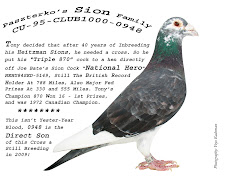
M. Paul Sion, of Tourcoing

By Dr. W. Anderson
The Sport of Pigeon Racing

I visited this world famous fancier for the first time in 1929, and I was particularly impressed by his marvellous collection of pigeons. I must first of all give a slight impression of his magnificent loft installation. The building was of four storeys; the ground floor housed his cars, the second floor his grain, baskets and odds and ends of loft equipment; the third was the old bird loft for widowhood and natural racing; and the fourth his young bird lofts. M. Sion was a keen gardener and was mostly interested in roses and sweet peas; his other interests included game cocks (of a rather heavier type than we see in this country), sporting dogs (especially setters) and shooting.

During my first visit I was able to purchase a good stock pair containing the "Vieux Gris" blood - BCC 87646/25 and BBH 44284/26. From the first, this pair did well and were grandparents of winners up to Rennes, 545 miles, and Nantes, 608 miles, and 1st Open Dol.

After my second visit I bought his No. 1 stock hen, a blue 605142; she had bred many winners for M. Sion and she also did well for me.

Later I purchased red chq cock "Admiration" 605297/29 when he was a yearling. I selected him and was able to have him only because he had been shot in the leg when returning from his last race and was permanently lame. M. Sion rightly considered that his racing days were over. "Admiration" left at Tourcoing a youngster which was to be M. Sion's National winner in a future year from Morceaux. With "Admiration" I also bought mealy hen 82288 who was the dam of champion "Rouge Macot".

M. Sion considered "Champion Rousselet" and "Champion Rouge Macot" his two greatest pigeons. I was fortunate in making these selections and especially before the stock from them had won their spurs in the long races. They therefore justified my selection.

In later years I got to know M. Sion and his son M. Robert Sion much more intimately and we found many interests in common. I was able to help him with plants, gun-dogs and even game cocks!

M. Sion presented me with "Champion Rousselet" and up to the war in 1939 he gave me all the birds I required.

A short description of the great pigeon "Ch. Rousselet" might be given at this stage. His ring number was 28/517634 and he was well known over the continent as M. Sion's "Black Eyed Cock". He was a winner of forty prizes up to 900 kilometres and he was the sire of many winners for M. Sion, including his best bird in 1934. He was also sire of M. Paul Van Ecke's (Ghent) two great winners in the Paul National. "Ch. Rousselet" was a direct son of M. Sion's "Old Grey" stud - of the "Vieux Gris". He was described by M. Sion as "one of the greatest glories of my loft". "Ch. Rousselet" in type was a perfect pigeon, of medium size, good head and black eyes (rather to my mind a dark shade of blue), beautiful body and wings. He was a strawberry mealy. In addition he was like "Ch. Epinard" and other great pigeons, quiet and tame, and easy to work with. He was one of the foundation stones in building my present Sion family.

"Le Rousselet" Red Mealy Cock, 28.517634, bred by M. Paul Sion and well known in Belgium and France as M. Sion's "Black-Eyed Cock," and is winner of over 40 prizes up to 900 kilos. He is sire of several Aces including his best bird in 1934, also of M. Van Ecke's two Sion Cocks (nest-mates) which put up wonderful performances in 1933 National races. "Le Rousselet" is described by M. Sion as follows: "A direct son of my old Grey Stud Cock which is one of the greatest glories of my loft. This bird alone will found a loft."
The birds enumerated and several others from the same source and from M. Robert Sion (his son) were the original stock from which my Sion family came.

They are essentially a hardier type of pigeon than the Stassarts and stand up to feeding their youngsters even as prisoners. They shine in difficult head winds and are courageous and reliable. They are also, as Dr. Bricoux and M. Stassart proved, a very reliable cross almost with any strain.

In 1946, after the war, and at M. Sion's request I sent him two pairs of my best Sion blood to help him to re-establish his loft. I have recently heard from his son, M. Robert Sion, that these are now in his loft and I am sure they will give a good account of themselves in future races. I am of the opinion that the son will worthily uphold the name of Sion in the pigeon world.

A few notes with reference to the origin of the Sion pigeons and regarding M. Paul Sion's methods should be of interest. The birds go back to a son of M. Gris Dugniol's (Paris) champion mealy cock who won consistently in the long races for ten successive years. This cock was of the strain of M. Kikkens of Antwerp - a family as well known at that time as that of Wegge or Cassier, etc. This cock was mated to a mealy hen of the Red Vekeman blood (Wegge) and produced a blue hen with "black eyes" which proved to be a champion in all the races. She was later mated to a cock of the blood of Pynen and Delathouwer. From this mating came the famous champion "Rouge Sion," who was a great winner and breeder of winners. Many of the latter were mealies which were strongly black ticked like the original old Dugniol cock, their grandfather. M. Sion conserved and cultivated this family for between thirty and forty years - the birds became his famous "Vieux Gris". M. Sion used a suitable out-cross occasionally - he was not a confirmed in-breeder.

His successes were phenomenal at all distances and especially when conditions were adverse. The birds were game and at all times dependable. I was impressed, in my numerous visits to the loft, by the uniform quality of the birds - he had always a preponderance of reds, red Cheqs, and mealies, and all these were of the same type. The young bird loft was occupied by a magnificent team. M. Sion never seemed to have a bad breeding season. Some of the birds were above medium size, but all without exception were robust and muscular. M. Sion was a champion racer and an outstanding breeder, two qualifications which are very seldom got at the same time. On inspecting and handling a pigeon typical of the Sion family I was always impressed by the fact that although the bird looked more than medium size he was seldom heavy and he appeared smaller in the hand. On the average the Sions are definitely bigger than the Stassarts or the Bricoux birds. They are good racers and good breeders. M. Sion was also a generous feeder and in his dietary used beans and vetches very largely. Both systems of racing were practised, natural method and widowhood. Success above the average was achieved by both methods; he did exceptionally well with his hens, but I think he preferred the system of widowhood and he practised this method with all the great enthusiasm of the expert. He was one of the greatest exponents of that game.

In his training of his youngsters he was an exacting taskmaster. They were thoroughly selected for physical fitness before being subjected to training and all came under starter's orders.

The Sion strain was very fashionable abroad and was introduced into many of the best lofts, e.g. by M. Stassart, Dr. Bricoux, etc. M. Ernest Duray who won the Pau National in successive years with "La Plume Blanche de Pau" was another fancier who set great store by the Sion family. His great winner was three-quarters Bricoux and One-quarter Sion.

Monday, July 18, 2011

Study Shows Some Features of Human Face Perception Are Not Uniquely Human

Ed Wasserman & Fabian Soto
University of Iowa

A study published by two University of Iowa researchers in the March 31 issue of the Journal of Vision found that pigeons recognize a human face's identity and emotional expression in much the same way as people do.

Pigeons were shown photographs of human faces that varied in the identity of the face, as well as in their emotional expression -- such as a frown or a smile. In one experiment, pigeons, like humans, were found to perceive the similarity among faces sharing identity and emotion. In a second, key experiment, the pigeons' task was to categorize the photographs according to only one of these dimensions and to ignore the other. The pigeons found it easier to ignore emotion when they recognized face identity than to ignore identity when they recognized face emotion, according to Ed Wasserman, Stuit Professor of Experimental Psychology, and graduate student Fabian Soto, both of the UI College of Liberal Arts and Sciences Department of Psychology.

Read more ...

Sunday, July 17, 2011

Young Bird Team

A fancier wanting success with youngsters should only place in his loft reserved for youngsters those that are in condition to be raced. All others should...

Discussed in The Practical Side of Pigeon Racing
by Leon Petit
May 1952

Saturday, July 16, 2011

Youngsters Fly Best

E. J. Sains says "Youngsters fly their best to the first set of eggs and youngsters."

Twenty words or less TCC Lost series


Friday, July 15, 2011

Pigeon Fly

There is a small black fly that lives in the pigeon's feathers. This fly is very dangerous because not only does it carry disease but it drinks the bird's blood. When crushed between the fingers, the fly bursts and appears to be full of blood. The pigeon's strength is sapped if an infestation of these flies occur. The young birds seem to be affected more than the old birds. The "Fly Season" is from September to November. When the youngsters are flying the long races (300 miles) and futurity races, they cannot perform at top capacity if infected with flies. Although there is no known deterrent to these insects, the three-week strip changing program usually keeps them under control. When the cold weather arrives, almost all of the flies disappear.

Taken from Rotondo Racing Pigeons
1980

A Classic book

Thursday, July 14, 2011

A Wing and a Prayer

The New York Times
By WYNNE PARRY
Published: October 28, 2007

WHEN Eduardo Urbina’s pet pigeon disappeared from his apartment in Spanish Harlem three summers ago, he suspected something nefarious.

Mr. Urbina, a street vendor who sells hats and watches along Third Avenue in the East 80s, recalled having seen a burly man with dreadlocks scooping live pigeons off Third Avenue with a fishing net, then depositing them into the back of his van. Mr. Urbina, who knows that pigeons are not in the habit of wandering off on their own, says he believed that the man with the dreadlocks had taken his bird.

In a town where pigeons have long been relegated to the status of pest, Mr. Urbina is part of a loose cadre of New Yorkers who see the birds as gentle, misunderstood creatures worthy of protection from human cruelty and indifference.

The problem of pigeon netting has continued unabated, and over the summer, organizations like the Wild Bird Fund, a local group, and In Defense of Animals, based in California, offered thousands of dollars in rewards for information leading to the arrest of netters, as the bird-nappers are known. A few months ago, an official of the American Society for the Prevention of Cruelty to Animals met with local pigeon protectors to discuss effective ways to address their complaints.

But Mr. Urbina worked alone.

He had been given this pigeon by a building superintendent when the bird was still tufted in yellow baby fuzz. He raised it to adulthood inside his apartment, feeding it seed through a straw and, later, from a dish, then released the pigeon outdoors — a routine he has followed with other rescued birds. Even so, the pigeon returned every morning through his apartment window for breakfast. One day, it did not.

“I loved that animal,” said Mr. Urbina, a soft-spoken 60-year-old who immigrated to New York 28 years ago from Peru. “So beautiful. So smart.”

He had heard rumors that netters lure the birds with food, then spirit them away to mysterious destinations. Many bird lovers believe that the pigeons become living targets at private gun clubs in Pennsylvania. Others say they end up in voodoo ceremonies, in the hands of pigeon breeders, at live poultry markets where they are sold for human consumption or at restaurants, particularly in Chinatown. And while catching wild birds like pigeons on the street is a violation of state environmental law, one New York police sergeant said that as a practical matter, enforcement is a low priority.

After Mr. Urbina’s pigeon vanished, he set up his own sting operation at Third Avenue and 103rd Street, near his apartment. A bakery on the corner discarded large bags of old bread that attract flocks of birds, and Mr. Urbina suspected that the birds would in turn attract the netter. Every morning for two months, he waited on the corner from 6 until after 7, his camera in hand.

According to Mr. Urbina’s account of what happened next, early one morning in late August, he finally saw his target driving north in a white truck. Along the way, the man would stop to park the truck, climb out and go after his prey with a long-handled net. Mr. Urbina pursued him, snapping photos as he went.

AFTER the netter sped off, Mr. Urbina hailed a taxi and sped north for six blocks, where he saw the netter scooping up more birds. Mr. Urbina leaped from the taxi and took photos of the truck, on the bed of which rested a portable pigeon coop. Turning away from the birds, the netter approached Mr. Urbina from behind, snatched his camera and drove off.

At this point, a police officer named Jon Stueckenschneider entered the case.

“I always refer to this case as my great pigeon caper,” said Sergeant Stueckenschneider, who at the time was an officer with a detective unit at the 23rd Precinct station house on East 102nd Street. He had been assigned to the case to investigate not the netting but the theft of Mr. Urbina’s camera.

The officer’s search for the thief ended the following February, when he got a call from police officers in the Bronx who had found the man in question. Subsequently, according to court records, a man named Dwayne Daley, now 49, pleaded guilty to possession of stolen property and was sentenced to the day he had spent in police custody. According to Mr. Daley — who identified himself in a telephone voice message as “the birdman” — the case was dismissed.

“My take on Dwayne Daley is he just wants to do his thing,” Sergeant Stueckenschneider said. “He might have felt Eduardo was invading his space by taking pictures.”

In a telephone interview, Mr. Daley said he had been fascinated by pigeons ever since he was a child trapping them in shoe boxes in Brownsville and East New York, the Brooklyn neighborhoods where he grew up. He now lives in Bushkill, Pa., near the Delaware Water Gap, where he keeps hundreds of birds, but he occasionally visits New York. He uses the birds he nets to interbreed with his own birds, he said, or sell at auction, where some can fetch more than $100.

“It’s not like I’m doing anything wrong with them,” Mr. Daley added. In his opinion, it is the birds’ defenders who do the real harm, by giving the creatures food that is meant for humans and that subsequently attracts rats.

Mr. Urbina never again set eyes on his 6-month-old pigeon, which he had named January, after the month he adopted it. But he did get back his camera, along with copies of the photographs he had taken. Exactly who had made the copies is unclear, but the final image showed Mr. Daley in the driver’s seat of his cab, wearing sunglasses and a half-smile.

Read more ...

Wednesday, July 13, 2011

Change in the Racing Loft

If you have a bird that is not racing as well as you think it should do, try changing its mate.

W. S. "Billy" Pearson
Widowhood Old and New
Edited by Colin Osman

Tuesday, July 12, 2011

Young Bird Racing

I have two young bird lofts adjoining each other, with a small sliding door between the two. I give my youngsters, as soon as they are strong on the wing, a toss of a few miles any time and in any direction. I generally start training seriously about three weeks before the first race and keep them at it whenever possible until they have reached the distance I want them to go. About a week before the first race, the sexes are separated and exercised separately for half-an-hour morning and evening.

At noon on the day of basketing for the first race I lift up the sliding door and allow both sexes to go together, and if so inclined, to make a fuss of each other. Separate them again the day following race (after a good bath) and carry on on same lines for second race. The third week I put in both lofts some small loose nest boxes and find that both sexes claim them. At noon on basketing day I again let them go together and find them very keen on getting a mate to the box they have claimed. Same method adopted for the fourth week.

The fifth week, nest bowls and nesting materials are given them two days before the race, but birds must not be allowed together until noon as in previous races. This will be found to again be an incentive and has suited me. I have not had a young hen lay for years.

I ought also to add that in the above races birds that have been to races are fed very lightly Saturday and Sunday; in fact, never get to real hard feeding until Tuesday evening's meal. Food generally being a good mixture of peas, tares, maize, and a little wheat at the evening meal. The morning meal being groats, rice, hemp, canary and rape. Only the morning meal on basketing days.

Teach your youngsters anything you think will be useful to them and you will find in after life they won't forget it. Get control of them and keep it. I find talking to them better than whistling or tin rattling. Pigeons have very often more sense than we who keep them, if given a fair chance to display it.

W. S. "Billy" Pearson
Widowhood Old and New
Edited by Colin Osman

Monday, July 11, 2011

Over Crowding

Over crowding is the single most important cause of loft stress. Twenty-five racing birds or six pairs of stock pairs in a loft section with a height, width and depth of 2 m is the maximum recommended number of birds to maintain health.

Taken from The Flying Vet's Pigeon Health & Management
by Dr Colin Walker